September 29, 2026·7 min read
Illinois ADA Website Lawsuits Jumped Over 500 Percent
Illinois federal website accessibility lawsuits rose from 93 to 585 in a year. Here's what drove it and why it matters even if you're not in Illinois.
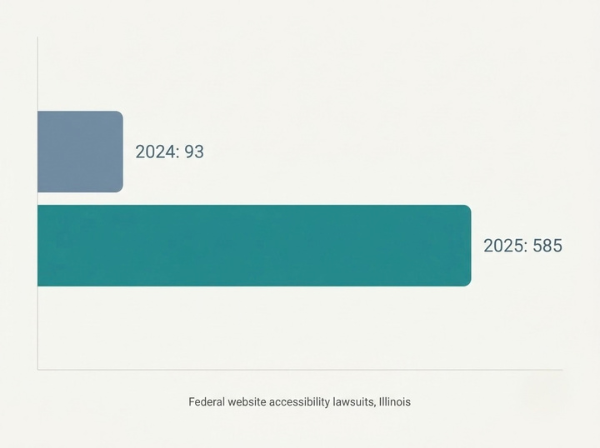
Federal website accessibility lawsuits filed in Illinois rose from 93 in 2024 to 585 in 2025, an increase of about 529 percent, moving the state from fifth place to third. The likeliest drivers are plaintiffs' firms shifting filings out of New York after federal judges there tightened their standing requirements, and a small number of very active firms. It matters outside Illinois too, because where a business can be sued depends on the facts of where it operates and sells, not only where it's headquartered. This article isn't legal advice, and an attorney who has read your specific situation is the right source for anything beyond the numbers.
Key Takeaways
- Illinois went from 93 federal website accessibility lawsuits in 2024 to 585 in 2025. That is roughly a sixfold jump, and it moved Illinois past Minnesota and Pennsylvania into third place, behind New York and Florida.
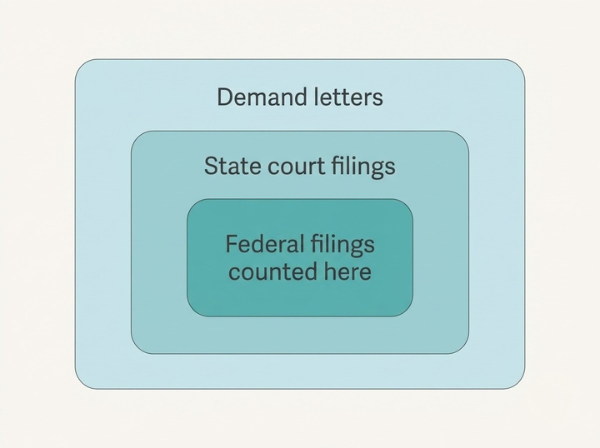
- This is a federal-court count, and it undercounts. Seyfarth Shaw, which publishes the figures, doesn't track state court filings, and demand letters that never become lawsuits aren't counted at all.
- Seyfarth's own read is that some New York plaintiffs' firms started filing in Illinois. Federal judges in New York had become more demanding about standing, which pushed filings elsewhere, including to state courts.
- A small group of firms drives much of the volume. UsableNet's 2026 midyear analysis found the 10 most active plaintiff firms account for about 84 percent of filings, and it named one Illinois-based firm as the single biggest driver of the 2026 surge.
- The complaints themselves are ordinary. The most commonly cited problems are still alt text, skip navigation, language attributes, form labels, and link or button names, and those are fixable.
The Numbers
Seyfarth Shaw tracks ADA Title III website accessibility lawsuits filed in federal court each year. These are the states where the change between 2024 and 2025 is clearest.
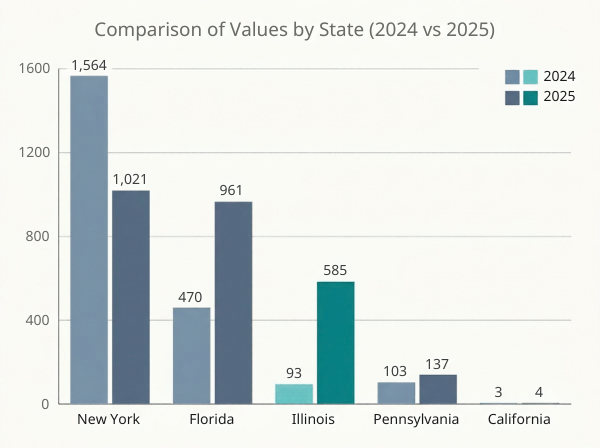
| State | 2024 | 2025 |
|---|---|---|
| New York | 1,564 | 1,021 |
| Florida | 470 | 961 |
| Illinois | 93 | 585 |
| Pennsylvania | 103 | 137 |
| California | 3 | 4 |
Nationally, plaintiffs filed 3,117 federal website accessibility lawsuits in 2025, up 27 percent from 2,452 in 2024. Illinois accounts for about 19 percent of that 2025 total.
Two notes on reading the table. California's near-zero federal count doesn't mean low risk there. Seyfarth attributes it to California courts having concluded that online-only businesses aren't covered by the ADA, which pushes activity into state court and toward businesses with physical locations, where the counts above don't reach. And different publishers report slightly different Illinois figures depending on how they count, so this post uses Seyfarth's numbers throughout as the primary source.
What Changed
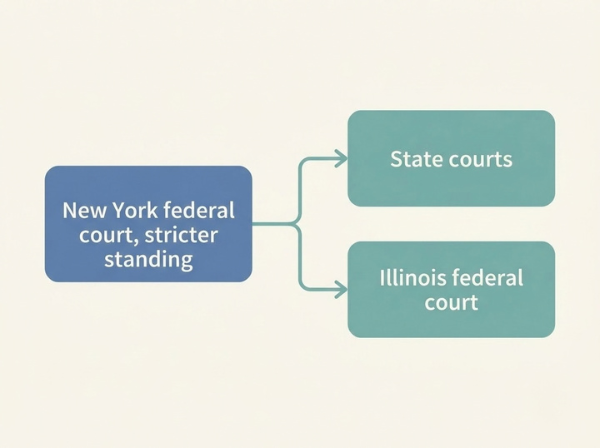
None of these explanations is confirmed as the complete story, and Seyfarth itself frames some of them as observations, not findings. Together they're the best-supported account.
Plaintiffs moved out of New York federal court
New York's federal courts were the busiest for years. Seyfarth notes that judges there have become more demanding about what a plaintiff must allege to establish standing, and that many plaintiffs have moved to New York and New Jersey state courts instead. In its 2025 midyear report, Seyfarth said Illinois was the year's big surprise and that some New York law firms that used to file heavily in New York were now filing in Illinois.
A small number of firms file most of the cases
UsableNet's 2026 midyear analysis, which covers combined federal and state filings through mid-June, found that roughly 20 to 25 plaintiffs, working with a small group of law firms, bring most digital accessibility lawsuits. It also found that Illinois had surged into second place behind New York, and it identified one Illinois-based plaintiffs' firm as the single biggest driver of the 2026 increase. When volume is concentrated in a few firms, a state's numbers can rise or fall quickly as those firms change where they file.
New plaintiffs' attorneys entered the space
Seyfarth also points to new plaintiffs' attorneys entering website accessibility litigation, and to how easy these cases are to file, since a plaintiff doesn't need to leave home to encounter an alleged barrier.
Why This Matters if You're Not in Illinois
Illinois is where the count jumped, but the more useful question isn't "are we based in a high-risk state." It's "where do we do business."
Whether a court in a given state can hear a case against an online business depends on the specific facts and the court's approach to personal jurisdiction. That's a question for an attorney, not a general guide. What the pattern does suggest is that geography is a weak predictor of who receives a claim. Filings follow plaintiffs' firms, and the firms follow whichever courts are most receptive at the moment.
There's a second reason the headline number is a floor. Federal counts leave out state court filings, and they leave out demand letters entirely. Researchers estimate demand letters outnumber filed lawsuits many times over, so the visible surge is a subset of the real activity.
The Complaints Are Usually Ordinary
The problems cited in these cases are rarely exotic. The categories most often named in real demand letters and complaints are alt text, skip navigation, language attributes, form labels, and link or button names. Those are all things a scan can find and, in most cases, a code fix can resolve. Related guides cover keyboard tab order and iframe titles.
What to Do Now
- Find out what's actually on your site. Axeazy's free scan checks your homepage in about 60 seconds and shows what a plaintiff's automated check would likely find.
- Fix real code, and keep a dated record. A timestamped record of genuine fixes, sometimes called a Good Faith Timeline, is what a lawyer or insurer wants to see if a claim arrives.
- Don't lean on an overlay. UsableNet's monthly tracker reports that in August 2026, 134 of the 432 defendants named in new lawsuits were using a third-party accessibility widget at the time.
- If you receive a letter, respond deliberately. What to do if you get a demand letter covers the first steps, and what these cases typically settle for covers the numbers. Talk to an attorney before replying.
Axeazy's Illinois page collects state-level filing context, and the Pro plan includes it. That context isn't a prediction about any specific site, and no scan can promise a business won't receive a claim.
FAQ
Did Illinois website lawsuits really rise more than 500 percent?
In federal court, yes. Seyfarth Shaw counted 93 in 2024 and 585 in 2025, an increase of about 529 percent. Other publishers report slightly different 2025 figures, such as 576, so the exact number depends on the counting method. The direction and scale are consistent across sources.
Why did this happen in Illinois?
Seyfarth's observation is that some New York plaintiffs' firms began filing in Illinois after New York federal judges became more demanding about standing. UsableNet's 2026 analysis adds that a small number of firms account for most filings, and one Illinois-based firm drove much of the 2026 increase. Neither is a complete explanation on its own.
I'm not in Illinois. Can I still be sued there?
It can depend on the specific facts, including where you do business and how a court approaches jurisdiction over online sellers. That's a legal question specific to your situation, and an attorney is the right person to answer it.
Do these numbers include demand letters and state court cases?
No. Seyfarth's counts cover federal court filings only, and they don't track state court cases. Demand letters that never become lawsuits aren't included, so the real level of activity is higher than these figures show.
Is the trend continuing in 2026?
UsableNet's 2026 midyear report projects roughly 6,000 or more combined federal and state filings for the year, and says Illinois has surged into second place behind New York. That dataset uses a different method than Seyfarth's federal count, so the two shouldn't be compared directly. Seyfarth typically publishes its full-year federal figures early the following year, so its 2026 count isn't out yet.
Sources
- Seyfarth Shaw / ADA Title III: federal website accessibility lawsuit filings, 2025
- Seyfarth Shaw / ADA Title III: federal website accessibility lawsuit filings, 2024
- Seyfarth Shaw / ADA Title III: 2025 midyear report
- UsableNet: digital accessibility lawsuits in 2026, five trends
- UsableNet: inside the 2026 midyear numbers
- UsableNet: 2026 midyear report overview
- UsableNet: monthly web accessibility lawsuit tracker
Want this in your inbox?
The ADA Alert. Weekly intelligence.
Every Tuesday: accessibility news, common WCAG issues, and code-level fixes. Free. Unsubscribe in one click.
Scope of every report we ship: SCOPE LIMITATION: This report documents violations identified by automated WCAG 2.2 AA scanning using axe-core v4.11.0. Automated tools identify approximately 30 to 40% of all WCAG criteria. This report does not constitute legal advice, guarantee ADA compliance, or protect against legal action. ADA compliance is a legal determination made by courts. For full WCAG conformance assessment, engage an IAAP-certified accessibility professional.