September 15, 2026·8 min read
Here's Everything Axeazy Doesn't Fix (On Purpose)
A tool that claims to fix everything can't be verified. Here's the honest, public list of what Axeazy doesn't touch, on purpose, and why that's the point.
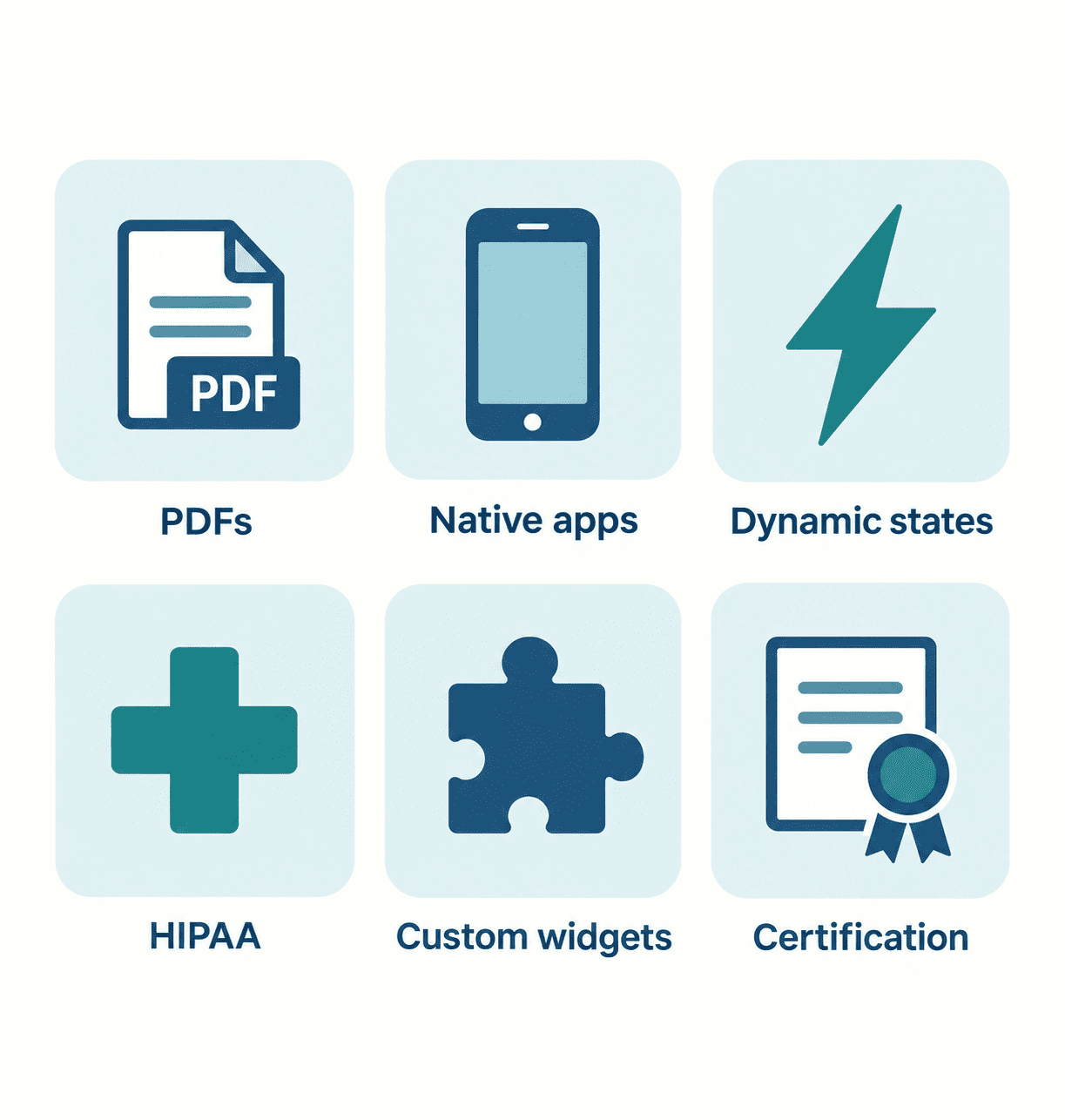
Axeazy doesn't fix everything, and the list of what it doesn't touch is public on purpose. PDFs, native mobile apps, highly dynamic real-time interactions, anything behind a HIPAA wall, fully custom ARIA widgets, and legal certification of any kind are all explicitly out of scope. A tool that claims to fix everything can't be checked against anything. A tool that tells you exactly where its edges are can be.
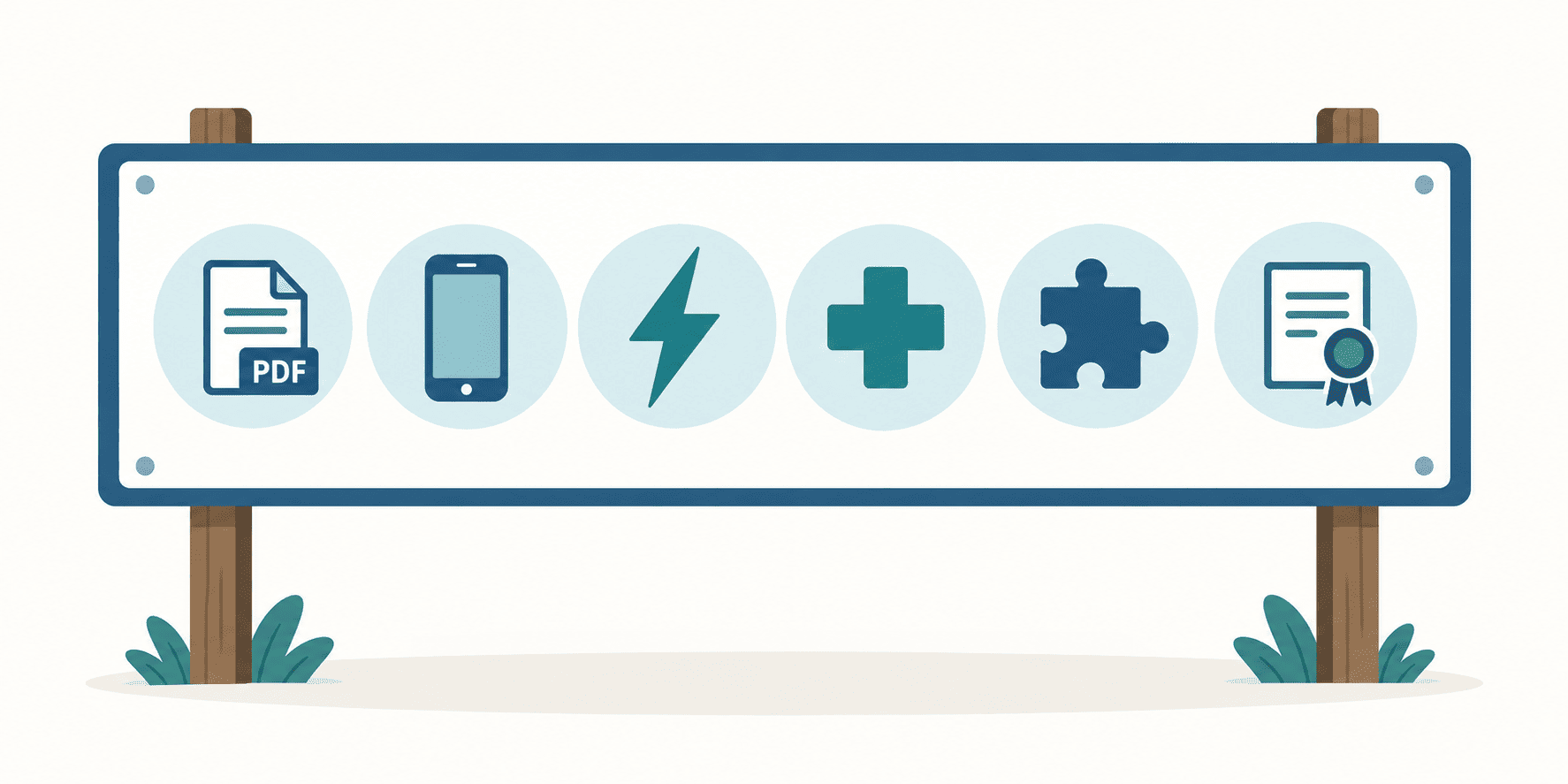
#Key Takeaways
- Axeazy doesn't touch PDFs. It fixes website code, a PDF is a different file format with its own accessibility rules and its own tools.
- Axeazy doesn't scan native iOS or Android apps. It works on rendered web pages, an app binary is a fundamentally different thing to test.
- Axeazy can't catch every problem in a highly dynamic, JavaScript-heavy interaction. A scan captures the page as it renders, not every possible state a complex app can enter during a live session.
- Axeazy isn't built for HIPAA-covered surfaces, like a patient portal or a telehealth login. A public marketing page for a healthcare business is fine. Anything that touches protected health information is not what this product is for.
- Axeazy won't design a fully custom, bespoke interactive widget's keyboard behavior from scratch. It can catch a missing or invalid ARIA attribute. Designing a correct interaction pattern for something nobody's built before is a human design decision.
- Axeazy will never issue a legal certification of compliance, because no one can. There is no official government body that certifies a private website's legal standing under the ADA. Anyone implying otherwise is selling something that doesn't exist.
#Why We Publish This List at All
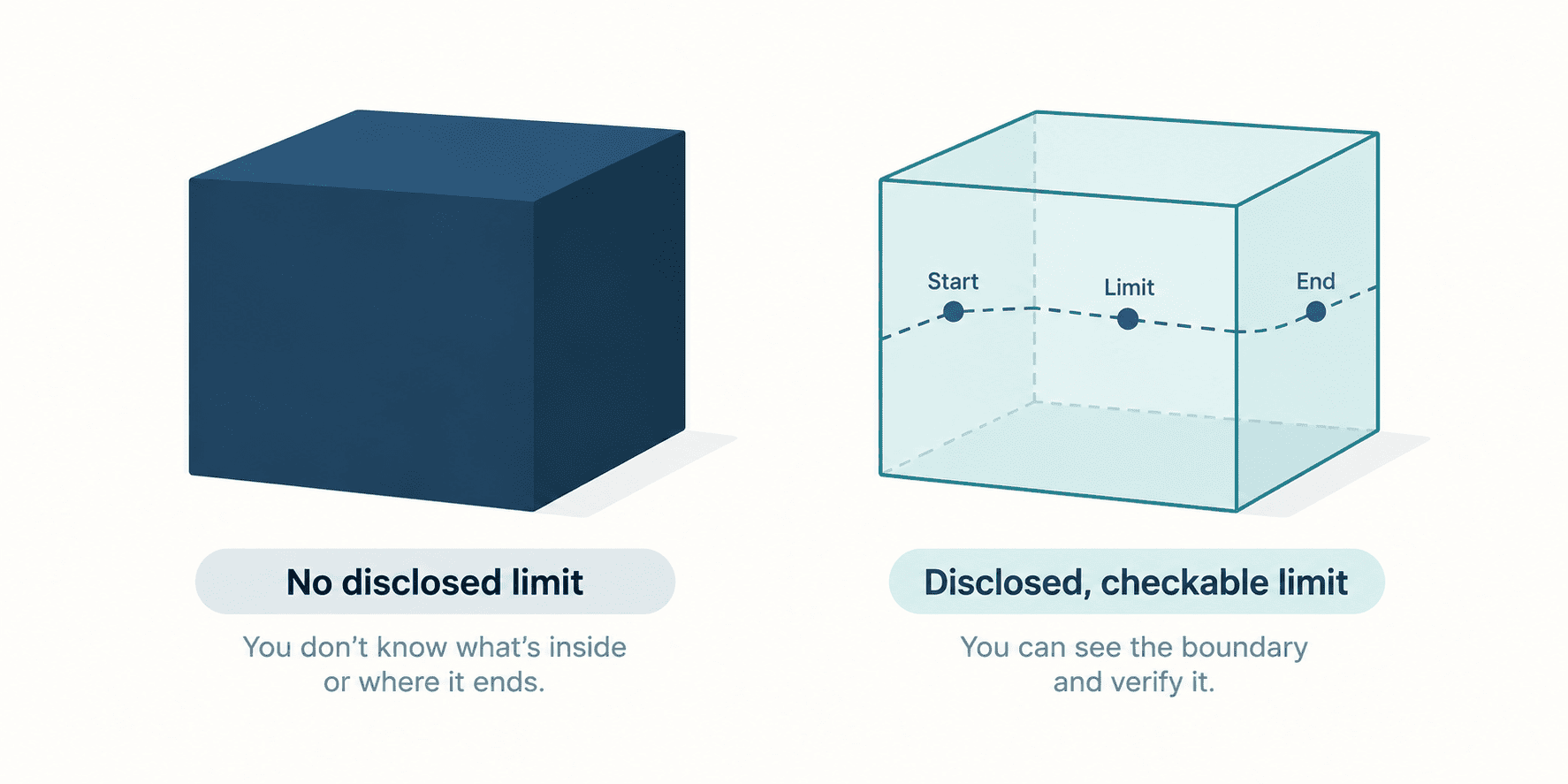
A tool that claims to handle everything is a tool you have no way to check. The claim just sits there, unverifiable, until something goes wrong and you find out the hard way what it actually didn't cover.
An overlay vendor found this out directly. In April 2025, the FTC finalized a $1 million consent order against one for claiming its product could make any website compliant with WCAG, a claim it couldn't back up with evidence. That's the risk of an unbounded promise: eventually someone checks it against reality, and reality wins.
A published boundary is different. It's specific, it's testable, and it doesn't get less true the more closely you look at it. That's the actual reason this list exists as a real page on the site, not a footnote. It's not a disclaimer buried in terms of service. It's the honest edge of what the product does, stated plainly, before you pay for anything.
#What Axeazy Doesn't Fix
#PDFs
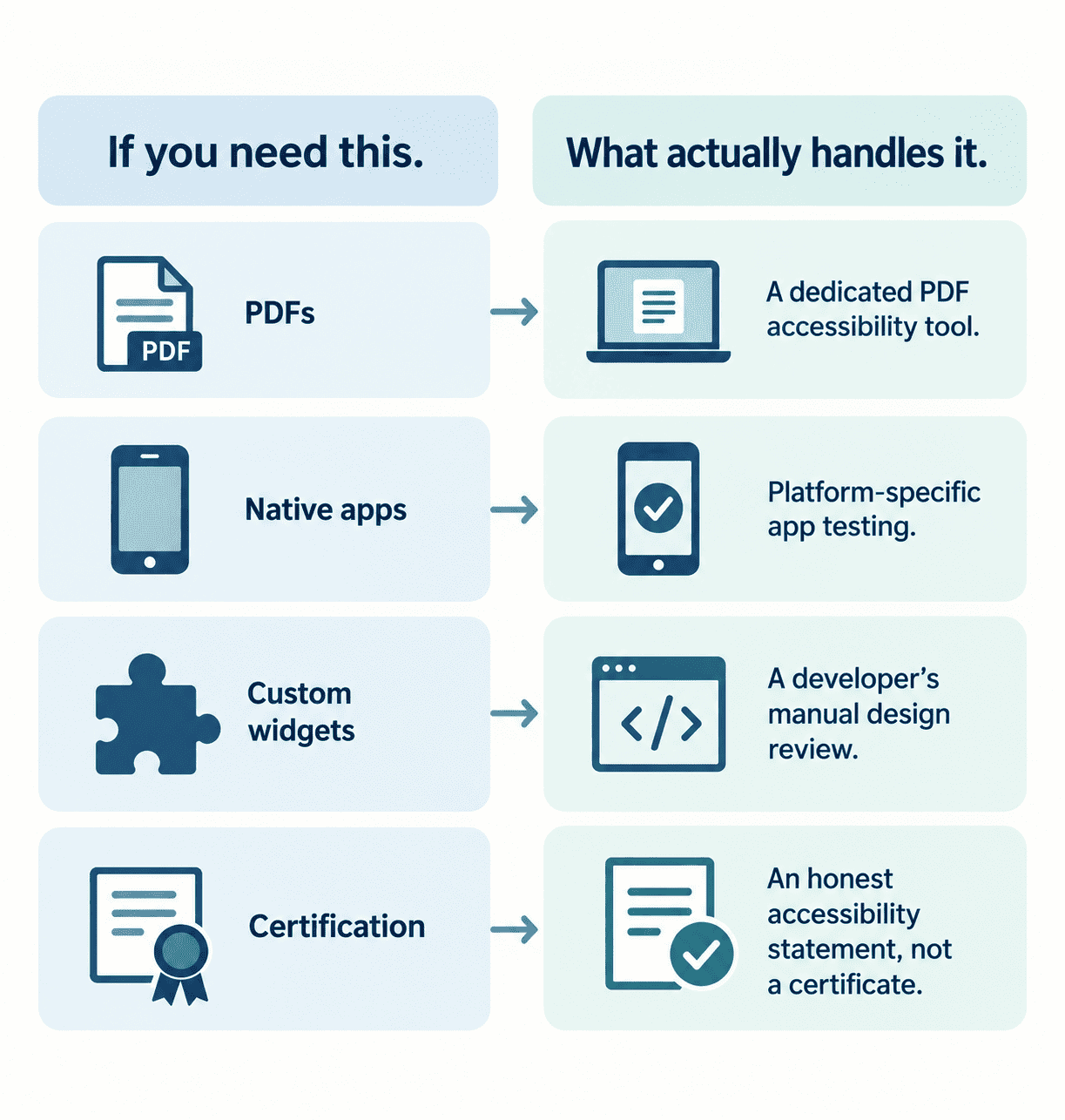
A PDF isn't HTML. It has its own internal structure, tag order, and accessibility rules, and a browser-based scan of a web page doesn't reach inside a linked PDF to evaluate any of that. If a business has a PDF menu, a downloadable form, or a brochure linked from its site, that document needs its own dedicated accessibility check, typically done with a PDF-specific tool built for exactly that job. Axeazy's scan and fixes cover the website itself, the page that links to the PDF, not the PDF's internal contents.
#Native Mobile Apps
axe-core, the engine Axeazy runs on, works against a browser's rendered page structure. A native iOS or Android app is a compiled binary with its own accessibility APIs, VoiceOver on iOS and TalkBack on Android, tested with platform-specific tools built for that environment. A business with both a website and a native app needs two separate accessibility efforts, not one tool covering both.
#Real-Time, Highly Dynamic Interactions
A scan evaluates a page as it renders at the moment the scan runs. A complex, JavaScript-heavy application can enter dozens of states a single pass won't see, a modal that only appears after a specific sequence of clicks, a live chat widget's dynamically loaded content, a multi-step interaction that changes based on what a user does. Axeazy catches what's present in the states it scans. A highly interactive product with many dynamic states still needs real manual testing on top of automated scanning, no automated tool gets around that.
#HIPAA-Covered Surfaces
Axeazy is built for public-facing business websites, not systems that handle protected health information. A restaurant, clinic, or salon's public marketing site, hours, services, contact forms, is exactly the kind of site it's built for. A patient portal, a telehealth session, or anything that requires being a HIPAA business associate is a different category of product entirely, with a different security and compliance posture Axeazy hasn't built for and doesn't claim to have.
#Fully Custom ARIA Widgets
Axeazy's fix engine can catch a missing or invalid ARIA attribute against a known, recognized pattern, a dropdown, a tab panel, a standard accordion. What it won't do is design the keyboard interaction model for a genuinely novel, custom-built widget from scratch. Deciding what arrow key should do what, what gets announced when, and how focus should move through something nobody has built before is a design decision that requires understanding what the widget is supposed to do. That's a person's job, not a pattern-matching one.
#Legal Certification of Any Kind
This one isn't really a limitation of the product, it's a fact about the world. No government body issues an official certification that a private website meets ADA requirements. There's no exam to pass, no seal to earn, no authority that signs off. Any accessibility vendor implying they can certify legal standing is describing something that doesn't exist. Axeazy will never claim a site has reached that status or been officially certified, not out of excess caution, but because those specific kinds of claims are the exact ones an overlay vendor got fined for making.
#What This Costs Us, and Why We Do It Anyway
Publishing this list means losing some deals to a competitor willing to imply their tool does more than it actually does. That's a real cost, not a hypothetical one.
It's also not a stable advantage for the other side anymore. The same honesty extends to the number that matters most: automated tools, Axeazy included, reliably verify roughly 30 to 40 percent of WCAG 2.2 AA's success criteria, not all of it, and the site says so everywhere, not just here. A vendor who won't tell you what their tool can't do is the same vendor who won't tell you what percentage of the problem they're actually solving. Once you've seen one honest limit, the absence of any limit elsewhere starts to look like exactly what it is.
#FAQ
#Does this mean Axeazy doesn't cover much of real accessibility work?
No. This list is specifically the boundary, not the whole product. Axeazy automatically fixes 14 categories of WCAG violations across ordinary website code, alt text, form labels, keyboard tab order, heading and landmark structure, and more, for any business running a standard website. This list covers the specific surfaces and situations that fall outside that, not the product's actual day-to-day coverage.
#My site has some PDFs on it. Is Axeazy useless for me?
No. Axeazy still scans and fixes everything on the HTML side of your site, including the page that links to those PDFs. The PDFs themselves need a separate, dedicated PDF accessibility tool built for that specific file format. Most small business sites have a handful of PDFs, not hundreds, so this is usually a small, separate task, not a blocker.
#Does Axeazy work at all for a healthcare business?
Yes, for the public-facing marketing site, hours, services, location, contact forms, exactly the kind of page most healthcare businesses need checked. It's not built for anything that touches protected health information, a patient portal or telehealth login, which is a different kind of system entirely.
#Will Axeazy ever fully automate custom ARIA widgets?
Automated tools can get better at recognizing more patterns over time, but a genuinely novel, custom-built widget will always need a person to decide what its correct behavior should be. That's a design decision about intent, not a syntax error a script can infer on its own.
#Why doesn't any accessibility company offer real legal certification?
Because no government body has created one to offer. There's no official certifying authority for private-sector website ADA compliance, no exam, no seal, no legal sign-off any vendor can grant you. Anything marketed as "certification" is a private company's own documentation, not a legal safe harbor.
#Sources
Want this in your inbox?
The ADA Alert. Weekly intelligence.
Every Tuesday: accessibility news, common WCAG issues, and code-level fixes. Free. Unsubscribe in one click.
Scope of every report we ship: SCOPE LIMITATION: This report documents violations identified by automated WCAG 2.2 AA scanning using axe-core v4.11.0. Automated tools identify approximately 30 to 40% of all WCAG criteria. This report does not constitute legal advice, guarantee ADA compliance, or protect against legal action. ADA compliance is a legal determination made by courts. For full WCAG conformance assessment, engage an IAAP-certified accessibility professional.